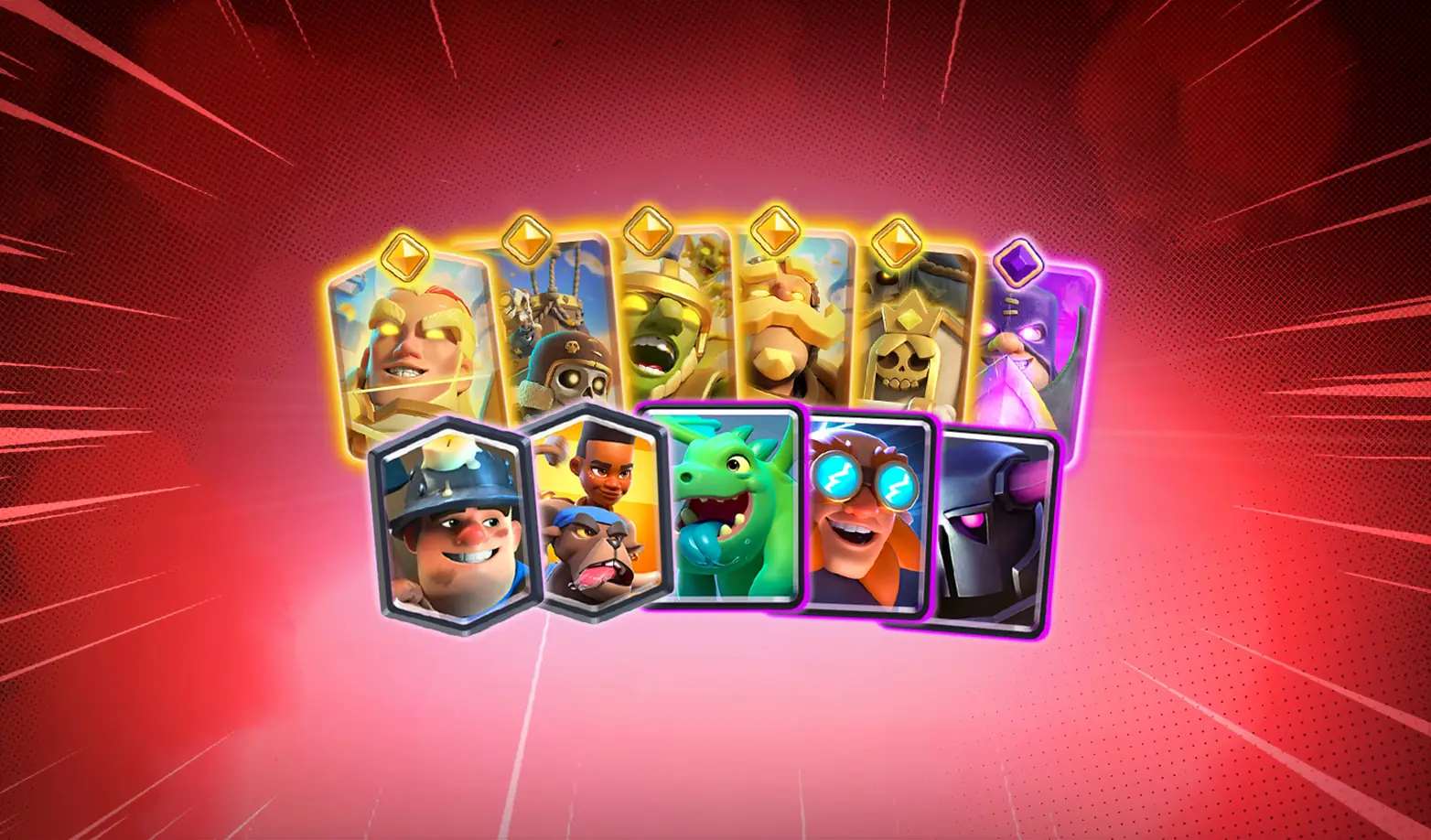
Balance updates usually move numbers. The one Supercell published for Clash Royale on 4 August 2026 does something different in three places: it takes a mechanic out of the game rather than adjusting it.
The largest of the three is one line in the Heroes and Champions section. Abilities no longer run on a cooldown. They are single-use.
The change, and the reason given for it
Supercell states it plainly: it does not believe ability cooldowns add enough meaningful gameplay to justify their complexity. Every ability becomes single-use as a result, with one exception — Boss Bandit, whose ability was, in the post's words, "designed for rapid consecutive activations".
That is a rules change rather than a tuning change, and the difference matters for how you read it. A cooldown is a resource you plan around across a match: you learn the interval, you count it, and you build sequences that assume the ability comes back. A single use is one decision, made once, and everything downstream of it — when to deploy the card, whether to hold the ability for a push or spend it on defence — is a different problem than it was last month.
July moved numbers. August removed systems
The contrast with the previous month is stark, and it is visible in the two posts side by side.
| Post | 6 July 2026 | 4 August 2026 |
|---|---|---|
| What changed | Eleven cards: damage, hitpoints, ranges, one ability cost, one spawn count | Card statistics, plus three mechanics removed outright |
| Ability cooldowns | Untouched — one ability's Elixir cost was reduced from 6 to 5 | Removed. All abilities single-use except Boss Bandit |
| Recurring healing | Untouched | Battle Healer no longer heals herself; Witch Evolution heals only from her first Skeleton wave |
| Spirits and Crown Towers | Untouched | All four Spirits no longer connect to Crown Towers on their own |
Nothing in the July post changes a rule. Every entry is a value: Hero Knight's shield hitpoints from 768 to 512, Hero Magic Archer's teleport range from 5 tiles to 3.5, P.E.K.K.A's damage from 816 to 842. You could disagree with all of it and still recognise the game underneath. The August post is the other kind.
The second removal: healing that keeps happening
Supercell's stated position on recurring healing is that it does not have a healthy place in Clash Royale in its current form. Two cards were reworked on that basis, and both were compensated with large increases elsewhere.
- Battle Healer no longer heals herself. Her damage rises from 148 to 268 (+81%), hitpoints from 1717 to 1920 (+12%), hit speed slows from 1.5s to 2s, and her heal radius drops from 4000 to 3000 (-25%).
- Witch Evolution now only heals from her first Skeleton wave. Her heal per Skeleton rises from 53 to 153 (+186%) and her maximum hitpoints from 1040 to 1451 (+40%).
The shape is the same in both cases. A card that produced a small effect indefinitely now produces a much larger one that stops. That is the same trade the ability change makes, applied to a different mechanic — and it is the clearest signal in the post of what Supercell is actually optimising for.
The third: free damage to the towers
This one is not announced as a policy, but it appears five times in a single post, and each entry names the Crown Tower.
- All four Spirits — Fire, Ice, Heal and Electro — drop from 230 hitpoints to 215 (-6%) and no longer connect to Crown Towers on their own.
- Goblin Drill's tower spawn damage is removed, so it no longer guarantees damage on Crown Towers; the Goblins it spawns do 4% more.
- Bowler and Executioner lose half a tile of projectile range, from 7.5 to 7, which the post says stops them clipping Crown Towers from behind the bridge.
- Hero Mega Minion's tower damage reduction goes from 50% to 75% and from lasting 5 seconds to permanent, refocusing the ability on troops.
- Wall Breakers' damage falls from 350 to 281 (-20%), which the post frames as reducing what they threaten against an unanswered tower.
On the Spirits specifically, Supercell publishes its own reason and its own evidence: it says the four have held a combined use rate of 53% in the Top 200 and 31% in Ranked across 2026, and that decks had begun cutting spells and support troops to fit them. Removing the tower-pressure dimension, it says, cements them as "distraction, cycle, and crowd-control cards".
Supercell says some of this may be undone
The reworks section opens with an unusual sentence for a patch note: these changes may be reverted if they do not have the desired effect. The post repeats the sentiment elsewhere — that the team will monitor Heroes and Champions and adjust the cards most affected over the coming months, and that Hero Tombstone will be reworked to target troops if the buff it received does not land.
That is worth reading as it is written. It is not a promise that the ability change is temporary; abilities are single-use now, and nothing in the post suggests otherwise. It is an explicit statement that several of the reworks around it are experiments with a review date, which is a reason to be slow about rebuilding anything on the strength of them.
How to use any of this
The method has not changed, and this article deliberately does not tell you what to play. What is worth extracting from a post like this one is the distinction it makes obvious:
Separate the rules from the numbers
A percentage is a question about breakpoints — does this card still die to the same spell, in the same number of hits? A removed mechanic is not. If a rule you relied on is gone, no amount of arithmetic recovers it.
Find the rule changes first
In this post there are three, and they are not in the section headed with the biggest numbers. Two of them are single sentences with no percentage attached.
Check the scaling before you compare anything
Both posts state that cards are scaled at Level 11, and that base-form changes usually affect a card's Evolution and Hero forms too. A number read at the wrong level is not the number you play with.
Wait for data before rebuilding
Your read on a rules change is a hypothesis until the ladder agrees with it. The reverts Supercell mentions are a second reason not to commit early.
The general version of that process — how to work out whether an update touches the deck you actually play, before you tear it apart — is set out in how to read a Clash Royale balance update. This month is the case it was written for.
One further note for anyone reading the Void rework, whose Elixir cost moves from 3 to 5: a change of that size is a change to what every hand costs you, not just to one card. Clash Royale elixir trades covers the counting habit that makes those swings legible.
How we worked this out
Every figure, quoted phrase and stated reason here is taken from two posts on Supercell's official Clash Royale blog — the July balance changes of 6 July 2026 and the final August balance changes of 4 August 2026 — both read on the access date in Sources. The comparison between the two months is a statement about those two documents, not about the game's history in general. Numbers are quoted as Supercell publishes them, at card Level 11, which is the scaling its own posts state. No claim is made about which cards, decks or play styles this favours: that requires post-update play data this article does not have and does not cite. Nothing here was established by playing the game.
Sources
- Final August Balance Changes (opens in a new tab) — Supercell (accessed )
- July Balance Changes (opens in a new tab) — Supercell (accessed )
- Clash Royale news archive (opens in a new tab) — Supercell (accessed )